


Description
Description

At a Glance:
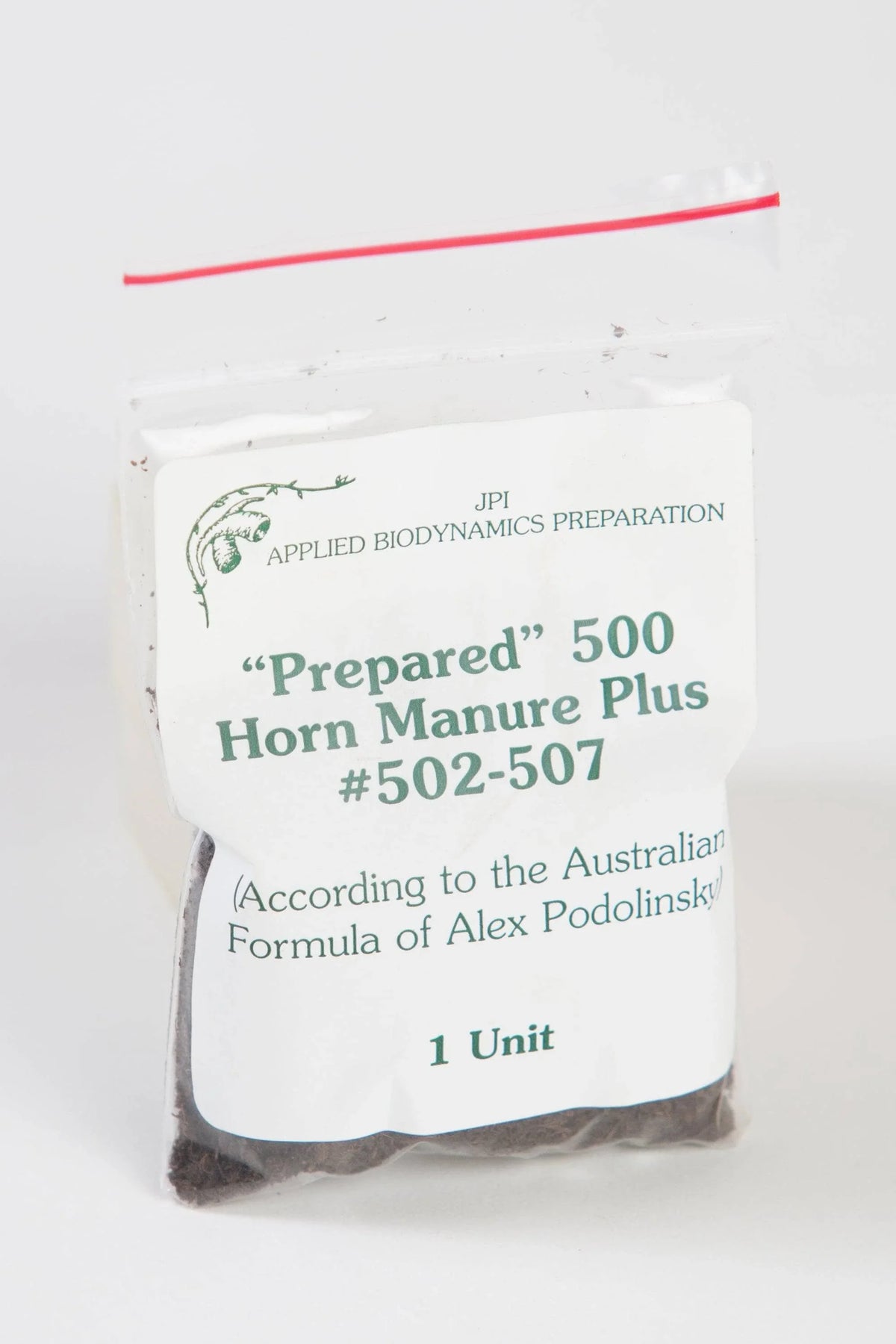
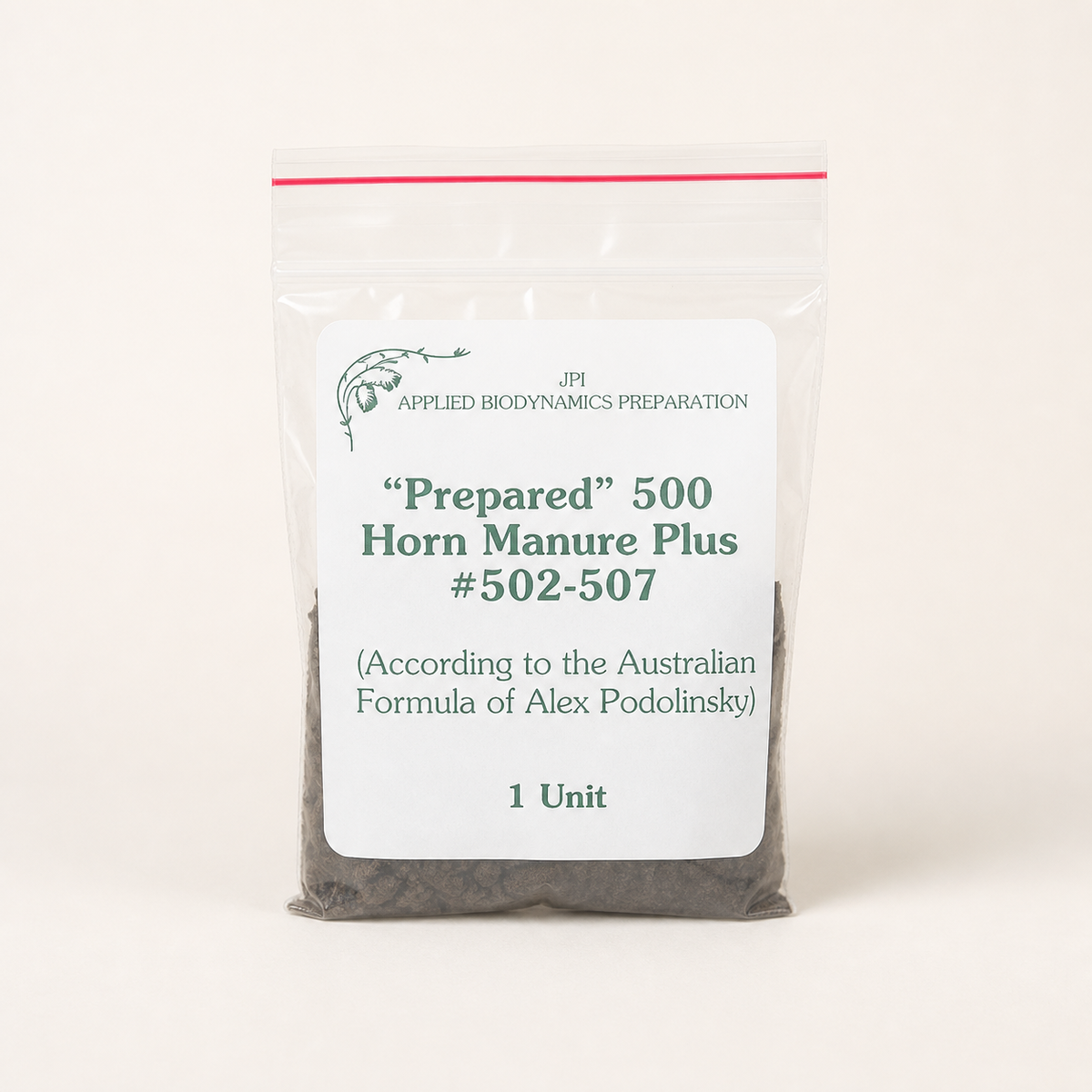
One unit is 1/4 cup.
One unit treats 1 acre.
What it does:
Prepared 500 combines finished horn manure (BD 500) with BD 502–507 for biodynamic soil care. JPI uses it in soil and root care; related 500K laboratory and 500P apple-orchard studies measured microbial responses in their respective settings.
How to use:
Stir one unit for one full hour in 3–5 gallons of water, then spray onto soil, preferably late in the day.
Ingredients:
Finished horn manure (BD 500) plus the six compost preparations BD 502–507.
🌱 Learn More about BD 500 Horn Manure
Product Details:
Biodynamic growers apply Prepared 500 to soil shortly before sowing or transplanting, or after cultivation, aiming to support soil activity and root development. Related prepared-horn-manure materials have produced measurable microbial responses in laboratory and apple-orchard settings, as summarized below.
Alex Podolinsky developed this prepared-horn-manure approach in Australia. He described using it from the start of biodynamic conversion rather than only after two years of ordinary BD 500. This product combines BD 500 with yarrow, chamomile, stinging nettle, oak bark, dandelion, and valerian (BD 502–507); it does not include BD 501 or BD 508.
Evidence note: A 2026 laboratory study found increased proliferation of selected compost-associated bacteria with an Italian 500K preparation. A 2022 apple-orchard study found time-dependent rhizosphere microbiome shifts after an Austrian 500P extract. These distinct studies used related materials and measured microbial endpoints; neither tested JPI's retail batch or crop yield.
Podolinsky on the structuring role of 500 and the other preparations
Podolinsky calls Preparation 500 “the structurer” and describes the other biodynamic preparations as working within that framework like differentiated organs. This is his account of their roles, not a change to their preparation or use. JPI’s Prepared 500 product here brings BD 500 together with BD 502–507 as listed above; ordinary BD 500 on its own and compost preparations used separately remain distinct products. Follow the current amount, stirring, and application directions on this page.
Source: Alex Podolinsky, Bio-Dynamic Agriculture Introductory Lectures, Volume 3 (1999), printed p. 35.
What did Carlo Noro’s water-jar comparison show about compost, BD 500, and Prepared 500?
Podolinsky reports Carlo Noro's comparison using equal jars, equal amounts of water, and equal amounts of material: compost disintegrated and mixed with the water in 0.5–1 hour; BD 500 held together for 2–3 days; Prepared 500 remained a colloidal ball without discoloring the water for over 30 days and had not fully broken down one year later. The longer persistence is a striking observation about the samples in water; this comparison did not measure root growth, soil biology, or crop yield.
Source: Alex Podolinsky, Bio-Dynamic Agriculture Introductory Lectures, Volume 3 (1999), pp. 54–55.
For additional information, visit: Preparation resources; BD 500 application instructions
Additional Article: BD 500: Reflections on Making BD 500
Please note: Quantities over 1 may be bagged together.
Prepared 500 after cultivation: white feeder roots and living humus
Podolinsky explains that cultivation can disrupt the structure and colloidal condition of active humus. He recommends Prepared 500 on newly cultivated vegetable soil so white hair roots develop with the growing crop and its uptake of elements, structuring the soil within reach of those new roots. He extends the root-reactivation principle to pasture following a dry autumn or winter wetness. Follow JPI’s current Prepared 500 amount and application directions above.
Source: Alex Podolinsky, Bio-Dynamic Agriculture Introductory Lectures, Volume 3 (1999), p. 54.
Inside Podolinsky’s book: staged water and Prepared 500 at Agrilatina
For Agrilatina’s sandy soil, Podolinsky describes this exact sequence for guiding green-manure roots deeper:
- After cultivation, sow the green manure.
- Give the first shallow irrigation before Prepared 500, wetting no deeper than about 10 centimeters.
- Walk out Prepared 500.
- Give a second shallow irrigation after Prepared 500.
- When the plants grow to about 20 centimeters, give one deep watering.
- Let the surface dry from the top downward so roots follow the water into deeper soil.
This is the field sequence in Bio-Dynamics: Agriculture of the Future, separate from the after-cultivation rationale above and from his other Agrilatina root observation. Follow JPI’s current Prepared 500 amount, one-hour stirring, and application directions for your site.
Source: Alex Podolinsky, Bio-Dynamics: Agriculture of the Future (2000), printed pp. 42–43.
Read the full step-by-step account on JPI’s Podolinsky at Agrilatina page.
Frequently Asked Questions
What is the main benefit of using Prepared 500 Horn Manure?
How should I apply the Prepared 500 Horn Manure?
What area does one unit of Prepared 500 Horn Manure cover?
What ingredients are included in the Prepared 500 Horn Manure?